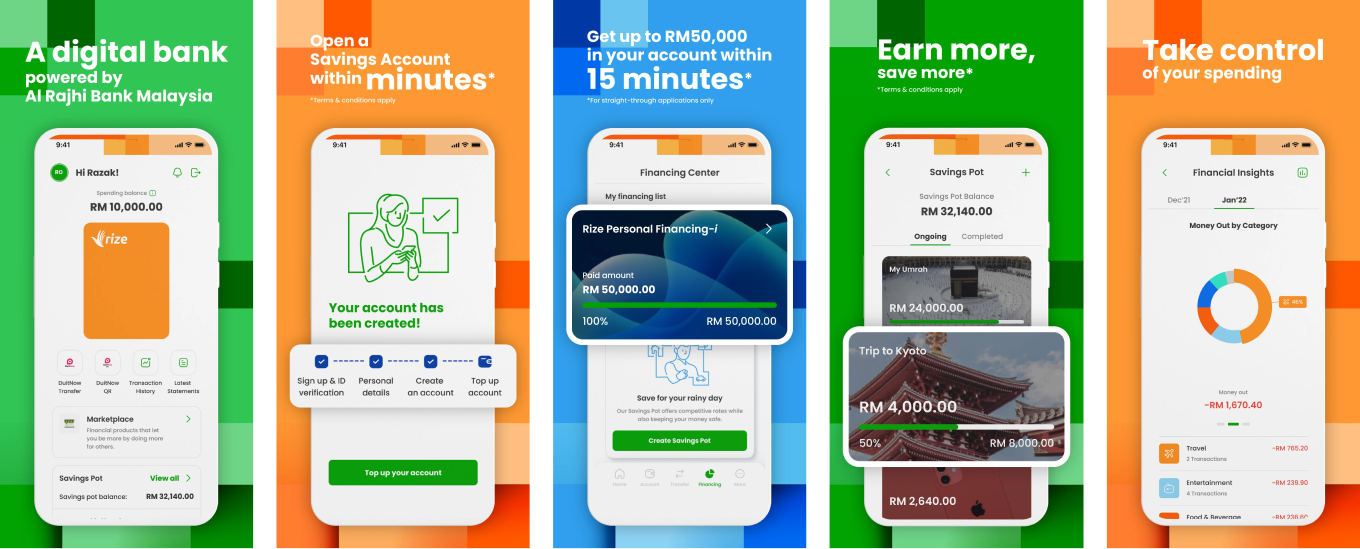
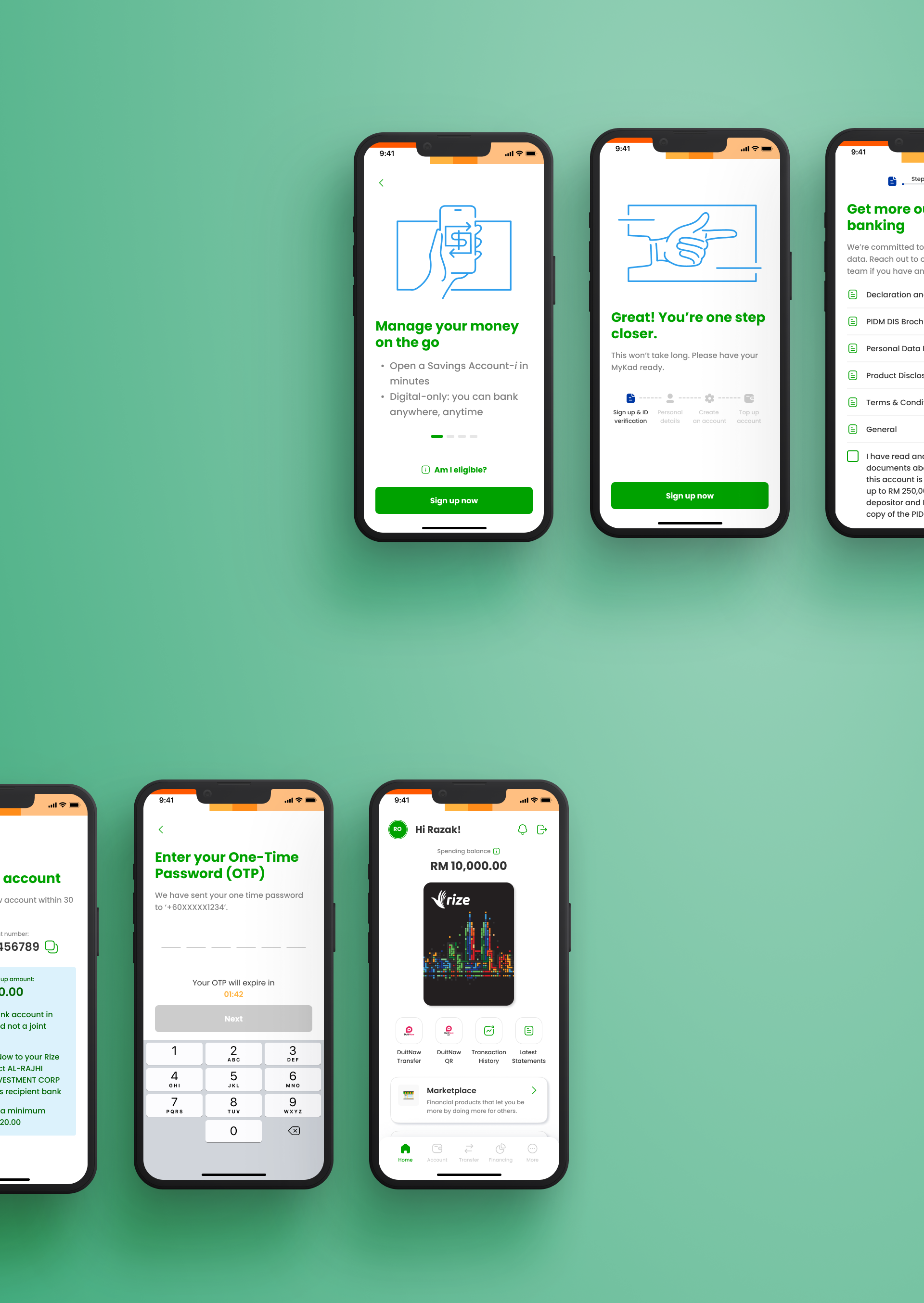
Contributed to the design of Rize, a fully digital banking experience launched by al rajhi Banking & Investment Corporation (M) Bhd, focusing on user-centric financial solutions.
My design work
My design work is under NDA, limiting public showcase as it is still under development with respect to the Bank plans and data is privacy. Happy to walkthrough upon request.
Company
al rajhi Bank Malaysia
Year
2022 - 2024
Overview
Rize is a digital bank that provides an end-to-end digital banking experience for customers by al rajhi Banking & Investment Corporation (M) Bhd (Member of PIDM). It was launched on 01 December 2022.
In June 2021, Al Rajhi Bank Malaysia initiated a transformative digital project named Rize—an Islamic digital bank in Malaysia. Successfully implemented by the end of 2022, it was officially launched in February 2023, providing customers with a fully digital onboarding experience to open savings accounts and manage personal finances. Rize earned acclaim as the Virtual Bank of the Year for Malaysia 2023 at the Asian Banking and Finance Retail Banking Awards 2023.
My role
UI/UX Product Designer creating digital solutions that not only meet the business goals and user needs but also to comply with regulatory standards and security protocols specific to banking and finance.
User Research
Ideation and Conceptualisation
Wireframing and Prototyping
Visual design
UX design
Design system
Collaboration with Cross-Functional teams
Prototyping and testing
Design Audit
UAT tester
What I did
Delivering end-to-end product design for digital banking.
Create and maintain Chinese social media platform - Xiaohongshu (XHS)
Analyse data error - root causes for onboarding journey
Tools
Jira (plan, track and manage workflows and projects)
Figma (design)
Confluence (repository of information)
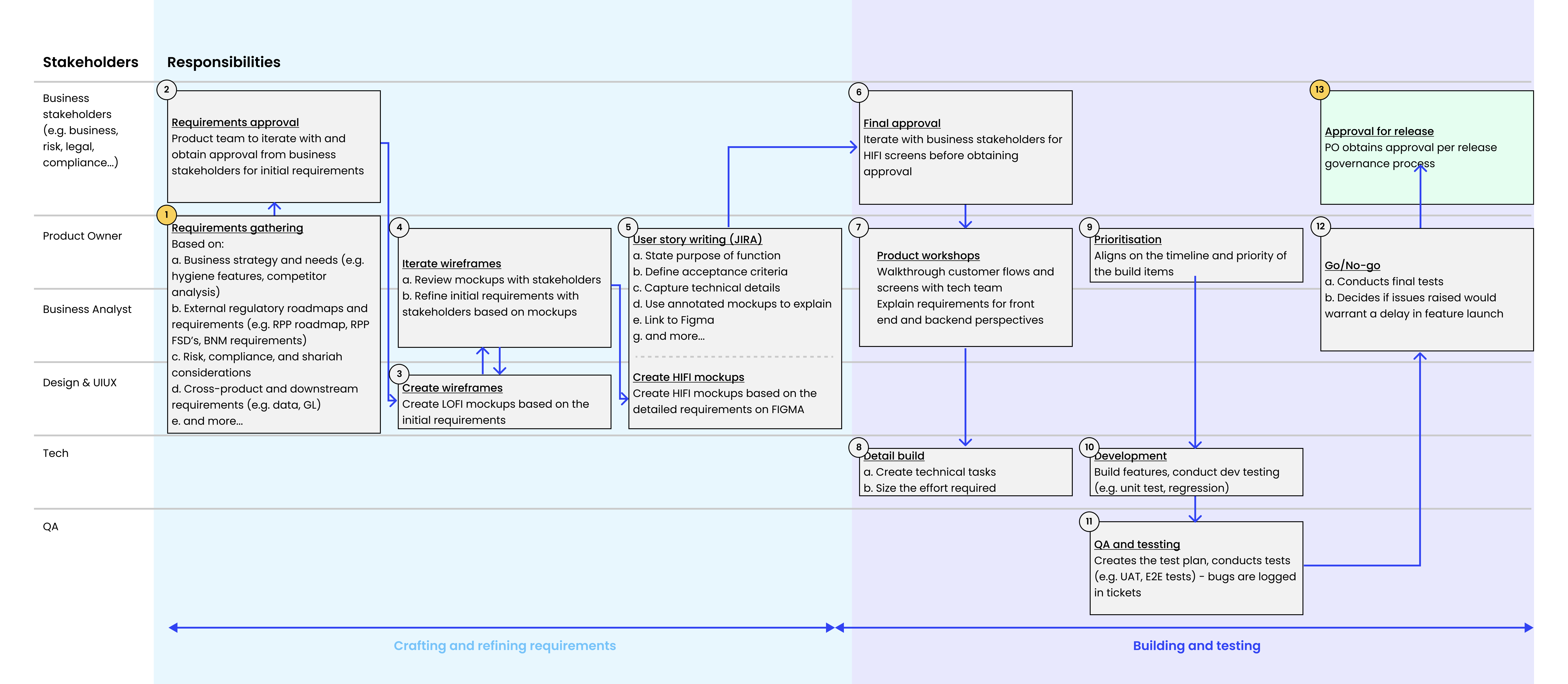
The product process
The UX process
Our UX process is non-linear because it doesn't adhere to a rigid step-by-step progression from one phase to another. Instead, it involves multiple interconnected stages that often require iteration and revisiting due to ever-changing decisions and requirements by the business and stakeholders involved.
for MVP process
Discovery - User research / Customer experience We have conducted focus group collaborated with a research agency to determine the target segment for this product. This was a qualitative research conducted 10 consumers focus group discussion at 2.5 hours with 6 respondents in each group. - Competitive analysis At the project's inception, we conducted a comprehensive competitive analysis to discern the comparative advantages of our app, products, and services over those of our competitors. This analysis not only aids the team in leveraging valuable insights for strategic decision-making and innovation but also constitutes an ongoing process that we consistently update to remain well-informed about evolving market dynamics.
Strategy - User personas - User stories & UIUX requirements
Design - Informational architecture - User flow and MIFI wireframe - Establish design system - HiFi screens
Validation - New product - Conduct usability testing sessions to validate whether any pain points with the design. During the session, we will observe how they interacted with the prototype. - Improvement/Enhancement product - Conduct A/B testing on the existing design/flow. - Conduct usability testing (if necessary) to validate the solution.
Development - All design handover for this project was through Figma to allow the engineers to inspect the file and export the HTML and CSS code. - We worked closely with the Front End team to spec out any missing interactions that were not covered in the design. - We conducted UX reviews of each front-end ticket that was implemented to ensure it was aligned with the design before it went live. - We conducted UX reviews for live products to ensure the verified version was launched and to identify and address any bugs.
for New feature / Improvement / Enhancement process
Project kickoff - Evaluate the problem statement or hypothesis - Ask the right questions - Is there previous work, research or analytics? - What are the business and user goals? - Are there any constraints we need to work within? - Project kickoff with developers - Flag any technical risks, considerations or spikes needed
Problem - Affinity mapping, group concepts and identify patterns - Map out the current user journey - Identify where the problem lies and/or the pain points - Establish the core need which relates to the problem
Research (skip if unknowns are low) - Competitive analysis - Data analytics - consult PO or insight team - User interviews to understand the problem qualitatively - Survey to gather quantitative data
Solution - Define problem from the research or prior knowledge - Ideation session with team based on key insights or pain points - Ensure stakeholders are aligned - Frequent check-in with developers and PO - Prioritise and evaluate the best solution given (development effort and impact on the goal)
Project handoff - Handoff session with team - Stay in touch throughout development - Help with QA if needed
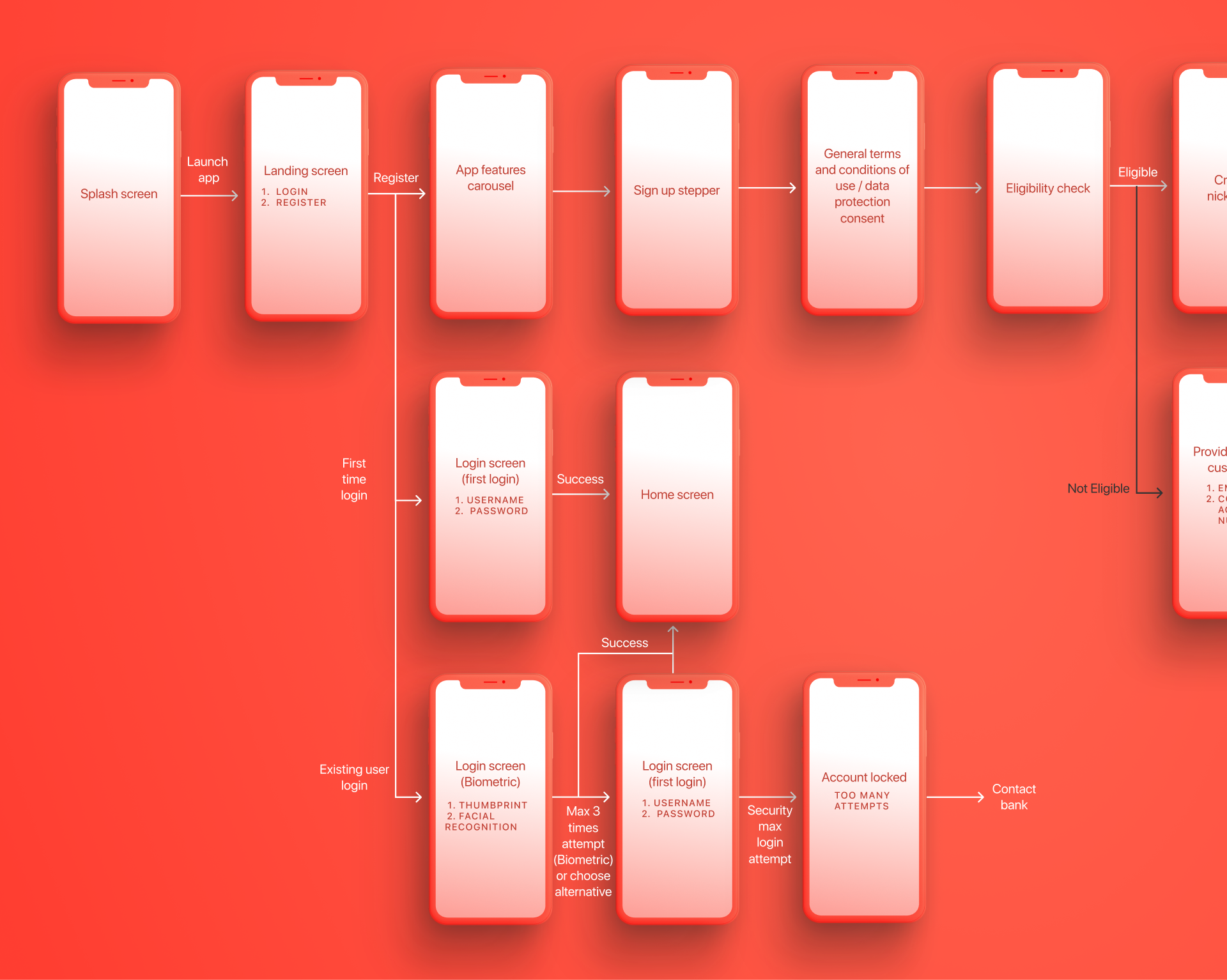
Sample of User Journey / Flow Diagram
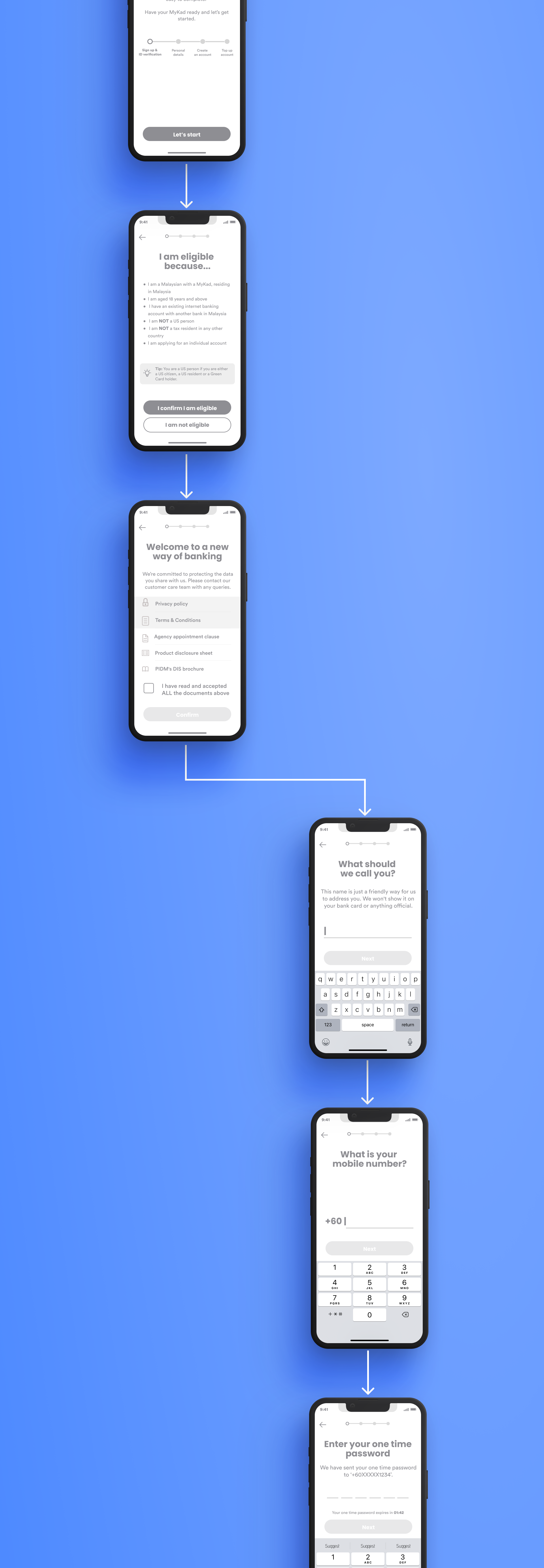
Sample of MIFI Wireframe / Interaction Design
Sample of HIFI
The challenges
Design works under combined of agile - waterfall approaches.
Company with low UX maturity, pushing designers to be more on UX advocacy than actual design.
Stakeholders too focus on quick fixes over long term solution.
Rely heavily on design to derive business/product requirements.
Failure to capture data hinders the design team's ability to conduct a thorough analysis of the issues.
Production was released to the public without adhering to the verified UAT. The development team failed to align with the UX flow design.
The lack of a well-defined business plan disrupts the design and development process.
Some key takeaways
Involve engineering upfront This help to reduce any rework later on as an understanding of the technical limitations upfront will help to inform your design strategy.
Effective communication and collaboration between teams In a digital bank, a hybrid approach that combines elements of Waterfall and Agile methodologies can address weakness on each in a way that aligns with the specific needs and pace of the digital banking environment.
The product roadmap is crucial It is essential for the product team as it aligns them with business goals, provides direction, aids in prioritisation, and facilitates effective communication with stakeholders.
Always take constraints into design consideration There are always constraints in all aspects. It is important to capture all of the presumed constraints for discussion so you can determine which ones are firm and which may be flexible. Regulations may be unavoidable, but people might be making assumptions about the way in which a regulation must be satisfied.